

If your website isn't on the first page of search results, you're invisible to 92% of potential customers. Most small business owners believe ranking is just about stuffing keywords into pages, but the reality is far more strategic. Search engine ranking determines whether your business thrives online or gets buried under competitors. This guide breaks down exactly what search engine ranking means, which factors truly move the needle, and affordable SEO strategies you can implement today to climb higher in search results and capture more qualified traffic.
Table of Contents
- Key Takeaways
- What is search engine ranking and how does it work?
- Core SEO factors that influence your search engine ranking
- How search engine ranking affects website traffic and business growth
- Nuances and advanced SEO insights every small business owner should know
- Boost your small business's search engine ranking with expert help
- FAQ
Key Takeaways
| Point | Details |
|---|---|
| First page visibility | Being on the first page drives the majority of clicks and leads, making top rankings critical for traffic. |
| Ranking factors overview | Ranking depends on relevance, authority, and user experience as evaluated by search engine algorithms. |
| Affordable tactics for SMBs | Small businesses should combine keyword research with high quality content and credible backlinks to improve rankings without large budgets. |
| Speed and mobile optimization | Technical speed, mobile friendliness, and local optimization can quickly boost rankings and attract locally relevant traffic. |
What is search engine ranking and how does it work?
Search engine ranking is the position of a website in search engine results pages (SERPs) for specific queries, determined by algorithms evaluating relevance, authority, and user experience. When someone searches for products or services you offer, search engines like Google scan billions of pages to decide which ones deserve the top spots. Your ranking position directly controls how many people see and click through to your site.
Search engines evaluate hundreds of signals to determine where your page belongs in results. These algorithms assess whether your content matches what searchers want, how trustworthy your site appears based on external validation, and whether visitors have smooth experiences on your pages. The process happens in milliseconds, but the impact on your business lasts much longer.
SERPs display results in order of perceived value to the searcher. Position one receives the most attention and clicks, with engagement dropping sharply for each lower position. Understanding this hierarchy explains why businesses invest in SEO. Better ranking means more visibility, which translates to more clicks, leads, and sales without paying for each visitor.
The key factors search engines weigh include:
- Content relevance to the search query and user intent
- Technical website performance like speed and mobile compatibility
- Authority signals from other reputable sites linking to yours
- User experience metrics such as time on page and bounce rate
- Freshness and comprehensiveness of information provided
These elements work together to create your overall ranking potential. No single factor guarantees top positions, but addressing multiple areas systematically improves your chances of climbing higher in results.
Core SEO factors that influence your search engine ranking
Core mechanics include on-page SEO (content, keywords, meta tags), technical SEO (speed, mobile-friendliness, crawlability), off-page SEO (backlinks, authority), local SEO for businesses, and content quality matching user intent. Each discipline contributes differently to your overall ranking power, and small businesses benefit most from understanding which areas deliver the fastest returns.

On-page SEO focuses on optimizing individual pages to be relevant and valuable. This includes researching keywords your customers actually use, incorporating them naturally into titles and content, writing compelling meta descriptions, and structuring pages with clear headings. Quality content that answers specific questions performs better than generic information that tries to cover everything superficially.
Technical SEO ensures search engines can access, crawl, and index your site efficiently. Page speed matters enormously, both for rankings and user satisfaction. Mobile compatibility is non-negotiable since most searches now happen on phones. Your site architecture should make sense to both visitors and search engine bots, with clean URLs and logical navigation paths.
Off-page SEO builds your site's authority through external validation. When reputable websites link to your content, search engines interpret this as a trust signal. Quality matters far more than quantity here. One link from an industry authority carries more weight than dozens from low-quality directories. Building genuine relationships and creating link-worthy content remains the most sustainable approach.
Local SEO becomes critical for businesses serving specific geographic areas. Claiming and optimizing your Google Business Profile, earning citations in local directories, and gathering authentic customer reviews all boost your visibility in local search results. Geographic keywords and location pages help search engines connect your business with nearby searchers.
Content quality must align with searcher intent to rank well. If someone searches for "how to choose SEO services," they want educational content, not a sales pitch. Match your content format and depth to what the search query implies. Comprehensive guides rank for informational queries, while product pages rank for commercial searches.
Tracking analytics reveals which SEO efforts actually move rankings and traffic. Monitor your positions for target keywords, organic traffic trends, and conversion rates from search visitors. This data helps you double down on what works and abandon tactics that waste resources. Many affordable SEO services include monthly reporting to keep you informed.
Pro Tip: Start with technical SEO improvements like site speed optimization and mobile fixes. These changes often deliver quick ranking gains because they remove barriers preventing search engines from properly evaluating your content.
How search engine ranking affects website traffic and business growth
Empirical data shows first page gets 92% of clicks, making top positions essential for capturing organic traffic. If your business ranks on page two or lower, you're essentially invisible to the vast majority of potential customers searching for what you offer. This dramatic click distribution explains why SEO investments focus obsessively on reaching the first page.
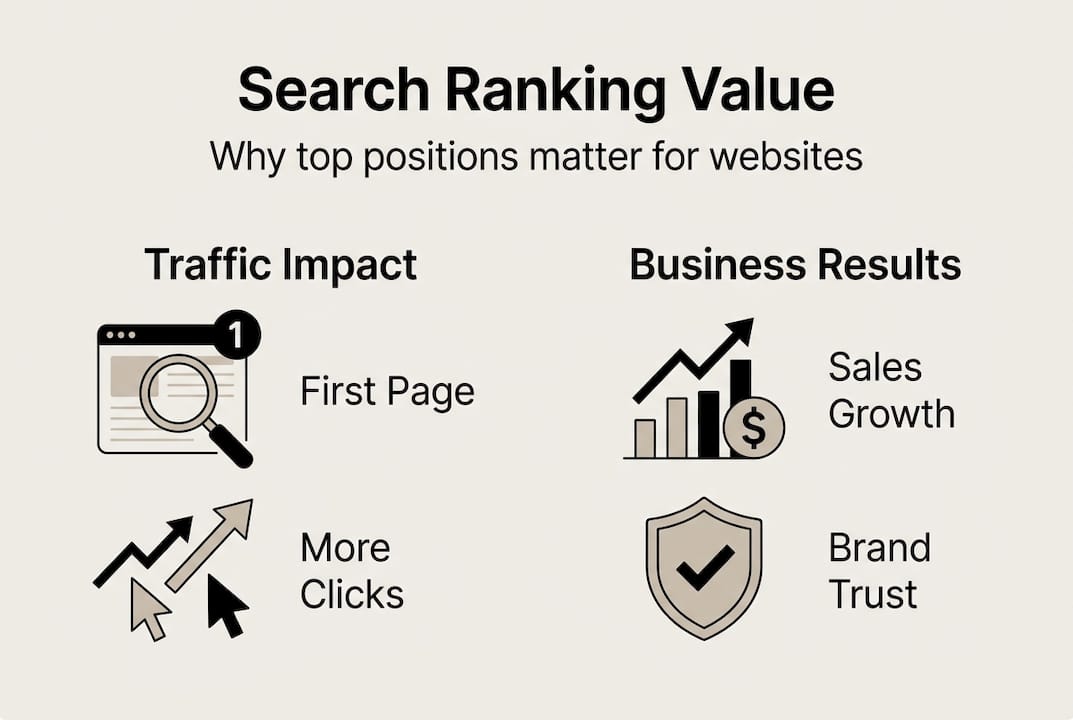
Organic search drives over half of all website traffic on average, significantly outperforming social media, paid ads, and direct visits combined. This makes search engine ranking one of the highest-leverage activities for business growth. Unlike paid advertising where traffic stops when spending stops, strong organic rankings continue delivering visitors month after month without ongoing costs per click.
Meta-analysis of SEO effectiveness confirms a high impact on rankings, traffic, and sales, with an effect size of 1.049. This statistical measure indicates that SEO produces substantial, measurable improvements in business outcomes when implemented properly. Small businesses see particularly strong returns because they often start from lower baselines and face less sophisticated local competition.
| Ranking position | Estimated click-through rate | Traffic impact |
|---|---|---|
| Position 1 | 28-32% | Captures nearly one-third of all clicks |
| Position 2 | 15-18% | Receives roughly half the clicks of position one |
| Position 3 | 10-12% | Still captures meaningful traffic |
| Position 4-10 | 2-8% each | Collectively receive remaining first page clicks |
| Page 2+ | Under 2% total | Effectively invisible to most searchers |
The table illustrates why moving from position five to position two can double or triple your traffic from a single keyword. Even small ranking improvements translate to significant business impact when multiplied across all your target search terms.
"Ranking on the first page isn't just about visibility. It's about credibility, trust, and capturing customers at the exact moment they're searching for solutions you provide. Every position higher means more qualified traffic and more opportunities to grow your business."
These traffic benefits compound over time. A page ranking well continues attracting visitors for months or years, creating compounding returns on your initial SEO investment. This makes organic search one of the most cost-effective marketing channels for small businesses with limited budgets.
Nuances and advanced SEO insights every small business owner should know
AI search (GEO) favors structured data/schema, with sites implementing it seeing 14% better bot engagement. As search engines integrate more AI-powered features like featured snippets and knowledge panels, structured data helps your content get selected for these prominent positions. Schema markup tells search engines exactly what your content represents, making it easier to match with relevant queries.
Backlinks and domain authority remain among the strongest ranking predictors despite Google's public emphasis on content quality. Real-world SEO experiments consistently show that pages with more high-quality backlinks outrank pages with superior content but weaker link profiles. This doesn't mean content doesn't matter, but it highlights that both content and authority signals work together to determine rankings.
Keyword optimization in URLs and addressing typos or local intent variations help improve local rankings. Small details like including your city name in URLs for location pages or creating content that addresses common misspellings of industry terms can capture additional traffic. Local intent signals like "near me" searches or city names trigger different ranking algorithms that prioritize proximity and local relevance.
| Factor | Google's official emphasis | Empirical SEO contest findings |
|---|---|---|
| Content quality | Primary ranking factor | Important but not sufficient alone |
| Backlinks | One signal among many | Consistently strongest predictor |
| User experience | Increasingly important | Moderate correlation with rankings |
| Structured data | Helpful for features | Strong advantage for AI search visibility |
| Technical SEO | Foundation requirement | Critical threshold factor |
This comparison reveals gaps between official guidance and real-world ranking patterns. Smart small businesses balance both perspectives, creating excellent content while also building authority through strategic link acquisition and technical optimization.
The evolving search landscape means staying informed about algorithm updates and new ranking factors. Voice search optimization, video content integration, and AI-generated search experiences all represent emerging areas where early adopters gain advantages. However, fundamentals like relevant content, technical performance, and authoritative backlinks remain consistently important across algorithm changes.
Many affordable SEO solutions now incorporate these advanced tactics, making sophisticated strategies accessible to businesses without enterprise budgets. Working with specialists who stay current on ranking factors helps you avoid wasting resources on outdated tactics while capitalizing on proven approaches.
Pro Tip: Add schema markup to your key pages, especially for local business information, product details, and FAQ sections. This structured data helps search engines understand your content better and increases your chances of appearing in rich results and AI-powered search features.
Boost your small business's search engine ranking with expert help
Improving your search engine ranking doesn't require guesswork or massive budgets when you partner with specialists who understand small business needs. Professional affordable SEO services deliver strategic optimization that targets the ranking factors most likely to move the needle for your specific industry and competition level. You gain access to expertise, tools, and proven processes without building an in-house team.

Expert help saves time while implementing current best practices that actually work. SEO changes constantly, and professionals stay updated on algorithm shifts, new ranking factors, and emerging opportunities. They handle technical improvements, content optimization, and link building systematically, letting you focus on running your business. Many SEO solutions for small businesses include transparent reporting so you see exactly how efforts translate to better rankings and more traffic.
FAQ
What is search engine ranking?
Search engine ranking is your website's position in search results for specific queries, influencing how much traffic you get. When someone searches for keywords related to your business, your ranking determines whether you appear at the top of results or buried on later pages. Higher rankings usually lead to more visitors and potential customers discovering your business.
Why is search engine ranking important for small businesses?
High search rankings increase your website visibility and organic traffic significantly. The first page of results captures 92% of all clicks, meaning lower rankings make you essentially invisible to potential customers. This visibility translates directly to more leads, sales, and growth opportunities for your small business without paying for each visitor like you do with advertising.
What are simple ways to improve my website's search engine ranking?
Focus on creating quality content with relevant keywords that match what your customers actually search for. Ensure your website loads quickly and works perfectly on mobile devices. Build local citations in directories and earn backlinks from reputable sites in your industry to increase authority. Consider professional affordable SEO services for cost-effective improvements that deliver measurable results.
How long does it take to see results from SEO efforts?
SEO improvements typically take several weeks to months to influence rankings noticeably. Search engines need time to recrawl your site, evaluate changes, and adjust your positions relative to competitors. Consistent effort and monitoring are key to long-term success, with most businesses seeing meaningful improvements within three to six months of implementing proper SEO strategies.